Monday, 28 April 2014
Thursday, 24 April 2014
Wednesday, 23 April 2014
Focus
“For a person to become deeply involved in any activity it is essential that he knows precisely what tasks he must accomplish, moment by moment.”
~ Mihaly Csikszentmihalyi
Tuesday, 22 April 2014
The Fiend
Like one, that on a lonesome road Doth walk in fear and dread, And having once turned round walks on, And turns no more his head; Because he knows, a frightful fiend Doth close behind him tread.
Samuel Taylor Coleridge
The Rimee of the Ancient Mariner
Thursday, 17 April 2014
Progress
From a piece originally written in May 2003. I doubt much has changed.
There seems to have been a debate raging in school physical education for many years. In one camp, kids should play competitive sports; they love to do this, and it prepares them for the competitive real world, as well as teaching them sporting values - 'sportsmanship'. The critics say that the less athletic children lose out, which is, to a point, true.
In the other camp, kids play contrived, essentially non-competitive games. Everybody gets and equal turn with the ball. Critics say this is pathetic, and is sheltering kids from the reality of adult life. Also largely true.
I remember when I was a kid, and I'm going back to primary school age here, what would happen whenever a football showed up in the playground. Two kids would put an arm around each other and start walking around each other in a small circle shouting "All join on for FOOT-ball!" repeatedly. As more kids joined both ends of this slowly rotating line it would get bigger and louder, and eventually most of the boys in the playground would have joined on (the girls were segregated in a different area, practicing their incomprehensible dark arts, like 'hopscotch'). At this stage there could be forty kids or more in the line.
Having reached critical mass, the line would stop rotating, and the two original instigators, who were now de facto team captains, would start picking their teams. The process was on the face of it fairly harsh, but no one at all seemed to mind. Captain A would pick a player, then Captain B, and so on until everyone in the line, including the no-hopers who could barely kick a ball, had been allocated to a team. If no goalkeepers volunteered, the 'floating goalie' contingency was invoked, and the game would commence. It would continue until the bell sounded for start of lessons.
It seems to me that the kids had solved at least some of the problems which routinely fox adults. The teams were uniquely well balanced, due to the process of selection. Inclusion was voluntary, not coercive, but absolutely anyone who joined the line would play, without being given a hard time, so most kids enthusiastically joined in irrespective of talent. The game was very definitely competitive, but because the identity of a team evaporated with the bell, the result of each game was largely irrelevant.
Which is kind of interesting, but not really a comprehensive solution to the school PE problem I guess.
I grew up in an era when more-or-less the be all and end all of school PE was sports of some kind. In other words, there was no actual physical education at all. If you were already reasonably good at running or football you did okay, otherwise you hated it, and in either case your learned absolutely nothing sustainable (apart from the mechanics of the sport in question). You did not learn about the paramount importance of taking responsibility for your own physical condition, the satisfaction of improving and developing your own capabilities and the near total irrelevance of comparing those capabilities with someone else's.
The most vital single factor in physical development and personal satisfaction is progression, preferably steady and consistent progress. When I was at school, if a kid could run the four-mile cross country in such-and-such a time, and you couldn't even run it at all, then he could run and you couldn't and that was that. No one told you what I didn't learn until my twenties - that if you can only jog a quarter of a mile without stopping, that's okay as long as you come back tomorrow and add a hundred yards or so. And that after a few years of this you, you useless no-hoper, will be running marathons.
And that this principle applies to virtually everything - running faster, running further, doing lots of press ups, lifting heavy weights. Just about the only important thing that a PE teacher could teach you I was never taught in god knows how many years of schooling.
I hope it's different nowadays. That would be progress.
There seems to have been a debate raging in school physical education for many years. In one camp, kids should play competitive sports; they love to do this, and it prepares them for the competitive real world, as well as teaching them sporting values - 'sportsmanship'. The critics say that the less athletic children lose out, which is, to a point, true.
In the other camp, kids play contrived, essentially non-competitive games. Everybody gets and equal turn with the ball. Critics say this is pathetic, and is sheltering kids from the reality of adult life. Also largely true.
I remember when I was a kid, and I'm going back to primary school age here, what would happen whenever a football showed up in the playground. Two kids would put an arm around each other and start walking around each other in a small circle shouting "All join on for FOOT-ball!" repeatedly. As more kids joined both ends of this slowly rotating line it would get bigger and louder, and eventually most of the boys in the playground would have joined on (the girls were segregated in a different area, practicing their incomprehensible dark arts, like 'hopscotch'). At this stage there could be forty kids or more in the line.
Having reached critical mass, the line would stop rotating, and the two original instigators, who were now de facto team captains, would start picking their teams. The process was on the face of it fairly harsh, but no one at all seemed to mind. Captain A would pick a player, then Captain B, and so on until everyone in the line, including the no-hopers who could barely kick a ball, had been allocated to a team. If no goalkeepers volunteered, the 'floating goalie' contingency was invoked, and the game would commence. It would continue until the bell sounded for start of lessons.
It seems to me that the kids had solved at least some of the problems which routinely fox adults. The teams were uniquely well balanced, due to the process of selection. Inclusion was voluntary, not coercive, but absolutely anyone who joined the line would play, without being given a hard time, so most kids enthusiastically joined in irrespective of talent. The game was very definitely competitive, but because the identity of a team evaporated with the bell, the result of each game was largely irrelevant.
Which is kind of interesting, but not really a comprehensive solution to the school PE problem I guess.
I grew up in an era when more-or-less the be all and end all of school PE was sports of some kind. In other words, there was no actual physical education at all. If you were already reasonably good at running or football you did okay, otherwise you hated it, and in either case your learned absolutely nothing sustainable (apart from the mechanics of the sport in question). You did not learn about the paramount importance of taking responsibility for your own physical condition, the satisfaction of improving and developing your own capabilities and the near total irrelevance of comparing those capabilities with someone else's.
The most vital single factor in physical development and personal satisfaction is progression, preferably steady and consistent progress. When I was at school, if a kid could run the four-mile cross country in such-and-such a time, and you couldn't even run it at all, then he could run and you couldn't and that was that. No one told you what I didn't learn until my twenties - that if you can only jog a quarter of a mile without stopping, that's okay as long as you come back tomorrow and add a hundred yards or so. And that after a few years of this you, you useless no-hoper, will be running marathons.
And that this principle applies to virtually everything - running faster, running further, doing lots of press ups, lifting heavy weights. Just about the only important thing that a PE teacher could teach you I was never taught in god knows how many years of schooling.
I hope it's different nowadays. That would be progress.
He Wishes For The Cloth Of Heaven
By William Butler Yeats
Had I the heavens' embroidered cloths,
Enwrought with golden and silver light,
The blue and the dim and the dark cloths
Of night and light and the half-light,
I would spread the cloths under your feet:
But I, being poor, have only my dreams;
I have spread my dreams under your feet;
Tread softly, for you tread upon my dreams.
Had I the heavens' embroidered cloths,
Enwrought with golden and silver light,
The blue and the dim and the dark cloths
Of night and light and the half-light,
I would spread the cloths under your feet:
But I, being poor, have only my dreams;
I have spread my dreams under your feet;
Tread softly, for you tread upon my dreams.
Monday, 14 April 2014
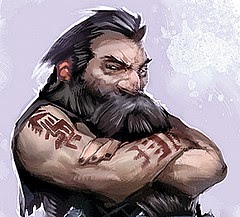
The Origin of Spatt G'dan Chukk
A couple of years ago I participated for a while in 'play-by-post' D&D - basically a form of collaborative storytelling with a complicated game layer on top (or beneath). The game I was in petered out when the dungeon master had to take a sabbatical, but I was fond of my character, so here for posterity is the origin of Spatt G'dan Chukk...
Spatt's father had been the legendary dwarf rogue Bax'n Ab Chukk, who met his untimely demise attempting an
ill thought through cesspit excursion when Spatt was still learning to dress and bevel bassalt. The size of the rogue's accumulated haul was the stuff of fevered speculation, but since Spatt was the Seventh Son of his industrious father's Ninth True Love, his dividend was likely to be meager, even if any would-be Executor had actually been able to locate Ab Chukk's estate in the first place.
"Spatt G'dan Chukk is a scar-cheeked dwarven fighter, freebooting vagabond and veteran of the Bactari Exsurrection, where with some gusto he had kneecapped over twenty of his taller Varellian foes with his swirling warhammer before the distraction of a boot lost to the mud gave an opportunistic half orc the chance to land a heavily gauntleted fist squarely on top of his helmet, simultaneously breaking his nose and jamming it over his eyes. Undaunted, Spatt had charged his adversary, oblivious to the fact that the malodorous meat loaf had already gone down in a welter of quarrels, and the resulting misadventure pitched the dwarf head first into a ditch where he spent the rest of the battle sleeping peacefully. Of the four hundred militiamen and irregulars who had turned out to face down the cynical land-grab that morning, only two dozen survived to kick the Baron's (by then) naked arse in the direction of the Fell Marsh, and each eyed the dazed looking miniature myrmidon with some suspicion as he waddled over from the steaming carnage at the long-vacated east end of the battlefield. ButSpatt had survived the letter of the battle, whether or not he'd bested the spirit of it, and a liberal smattering of beer-sodden embellishments sown amongst the ale houses of the Southern Palatine were sufficient to etch his name in history, to the extent that it would give him a head start in securing any reasonable commission that took his fancy.
Spatt's father had been the legendary dwarf rogue Bax'n Ab Chukk, who met his untimely demise attempting anill thought through cesspit excursion when Spatt was still learning to dress and bevel bassalt. The size of the rogue's accumulated haul was the stuff of fevered speculation, but since Spatt was the Seventh Son of his industrious father's Ninth True Love, his dividend was likely to be meager, even if any would-be Executor had actually been able to locate Ab Chukk's estate in the first place.
Spatt's powers of concentration were not high, and having never mastered the art of abating an adoquin abutment he decided at the tender age of 40 to sign up with The King's Own Overground Legion, Seventh Cohort, 3rd Cave Group. A grumpy but productive apprenticeship ensued, ending in an unfortunate misunderstanding over the contents of the Cave Group Commander's back pack, whereupon Spatt found himself abandoned a hundred leagues from home, and deeply mistrustful of any animal able to convey him back there before his beard turned grey.
And so, armed only with his genetic predisposition to larceny and a crude, low altitude competence with hafted weapons, Spatt Waz Bax'n Ab G'dan Chukk set off to make his fortune in this world, or any other that took his fancy..."
Subscribe to:
Posts (Atom)